
Establish the Culture Strategist stance
Define the system. Slow the rush to explanation. Start with what is actually happening.
A 60-Day Systemic Intelligence Immersion
You've spent years honing your craft: building trust, asking powerful questions, and helping clients create meaningful change.
Your next professional edge isn't another coaching tool. It's learning to see the larger system shaping the people, relationships, and organizations you're asked to help.
The Culture Strategist Playbook builds your ability to read and shift hidden dynamics behind difficult client and culture challenges.
You don't leave behind what makes you effective.
You expand what you can see, understand, and influence.
For years, I built my practice through coaching, leadership development, Emotional Intelligence, and approaches such as Co-Activity, NLP, and Appreciative Inquiry. They taught me how to work deeply with the person in front of me, and I wouldn't trade a minute of that experience.
But the longer I worked with leaders and teams, the more I sensed that some of what I was seeing couldn't be explained by the person alone.
That led me to a question that changed my practice:
What if the visible problem is being generated or sustained elsewhere in the system?
Instead of rushing to fix what was in front of me, I studied system-level models and learned to investigate the broader field of roles, history, loyalties, exchange, and patterns.
That shift changed how I understood workplace culture and relationships. It also changed how I described my work and the kinds of challenges I wanted to take on.
Systemic Intelligence gives you a wider lens.
Culture Strategy turns that lens into a disciplined way of working.
Culture Strategist is not another job title to paste onto a LinkedIn profile. (Although I will encourage you to do so!)
Rather, it names an important aspect of the practitioner you are becoming.
Can work with the individual AND read the system around the individual.
Can help solve a problem AND reveal where that problem may actually be produced.
Can form a systemic hypothesis AND remain willing to test it.
Is increasingly valued for judgment and discernment, not simply for sessions, facilitation, or a collection of tools.
The Culture Strategist Playbook is built around one live client, leadership team, department, partnership, business unit, or other meaningful micro-culture you engage with at work or in your community.
You bring a real system you can observe and investigate, and we’ll use it as your lab.
Over 60 days, across five private advisory sessions, every new Systemic Intelligence lens goes straight to work on your case. You learn the framework, test what you're seeing, gather evidence, and keep refining your assessment of where to apply systemic leverage.
Learn it → See it → Map it → Test it → Act on it.
Define the system. Slow the rush to explanation. Start with what is actually happening.
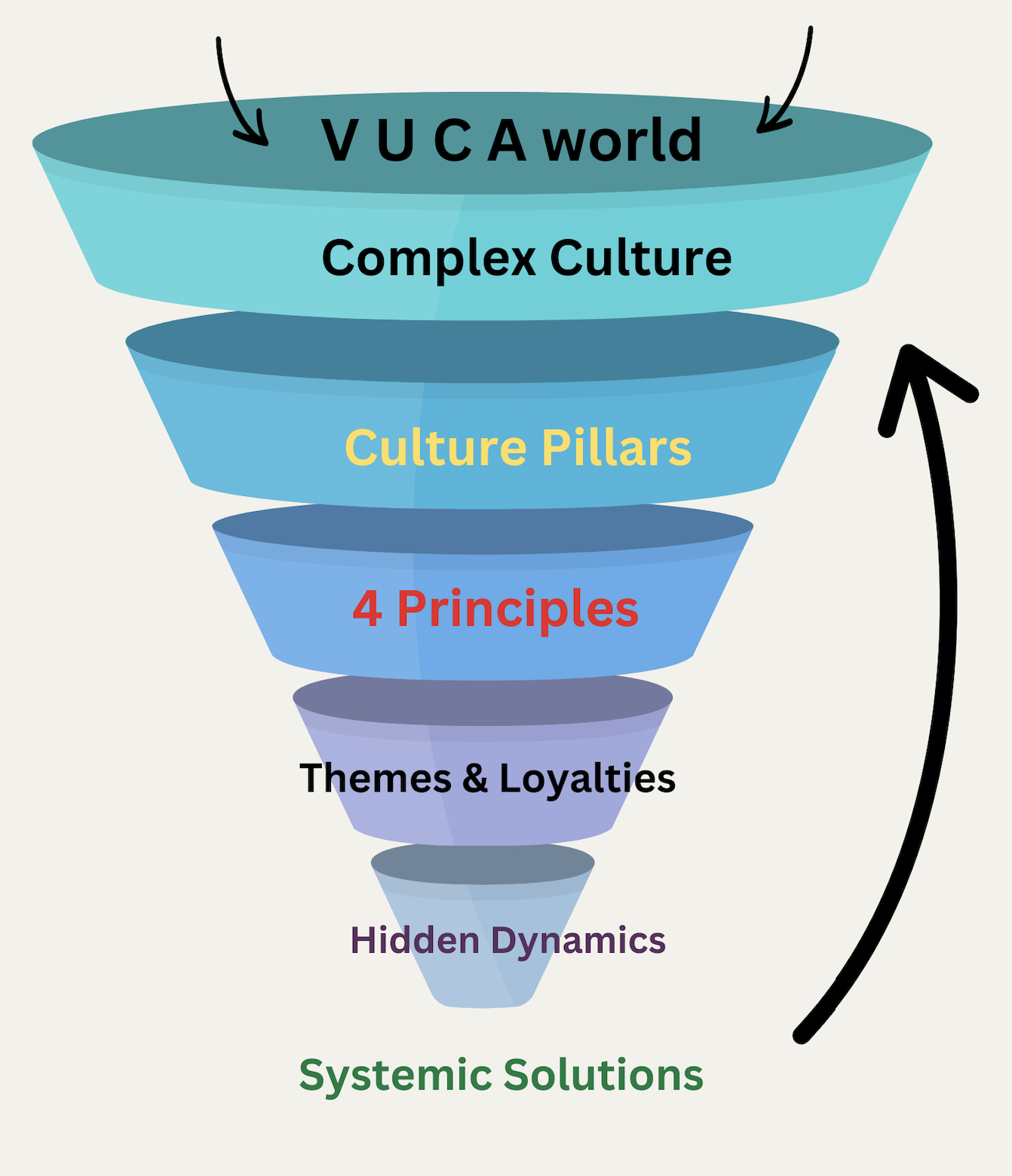
Use the Principles, Culture Pillars, and Field Conditions to widen what you can see.
Distinguish event, pattern, and possible system-level dynamics. Build the Culture Dynamics Diagnostic Map.
Develop and test hypotheses about what may be giving the pattern its staying power.
Identify leverage and build a Solutions Map with attention to timing, sequence, and consequences.
If you have a client or work group with a recurring problem, the Recurring Problem Assessment gives you a first experience with SI in about 20 minutes.
Recommended as an introduction to the SI framework. Not required for CSP enrollment.
The CSP modules give you the framework.
Your live case gives you the field.
The private sessions are where the two are calibrated.
Across five one-to-one working sessions with Craig, each lasting 45 to 60 minutes, you bring your case into the room to explore what you're seeing through the SI frame, identify what still needs evidence, and strategize where leveraged action will be most effective.
Direct mentorship, coaching, and calibration are central to the CSP.
The goal is to get you up to speed on SI and help you develop your own reliable systemic judgment in 60 days.
CSP includes an additional private session for follow-up, integration, and a check-in on what's next in your SI journey, about 15 to 30 days after the 60-day immersion.
By then, you will have had time to apply the skills independently and take a detailed look at what works, what surprised you, and where you still need calibration.
Activating Systemic Intelligence doesn't mean you need a large pile of new information.
You need a place to refine how you perceive and read hidden dynamics.
The founding rate recognizes the role early participants will play in helping refine the program through substantive feedback and real-world application. They receive the full high-touch private experience at the founding rate while the program continues to mature.
If you fully engage in the CSP, complete the work, attend the advisory sessions, and genuinely apply Systemic Intelligence to your case, yet finish the program without confidently using the core framework, Craig will continue working with you for up to 30 additional days at no additional cost to help you achieve functional confidence.
This is a commitment to the learning process, not a money-back guarantee.
Not necessarily. However, the RPA is highly recommended because it provides a practical first experience with the Systemic Intelligence frame. It is the pathway many people take to the CSP, but it is not required.
Because of the program's personal nature, enrollment begins with a private Fit Conversation with Craig. All private conversations, whether during the Fit Conversation or throughout the CSP, are kept strictly confidential.
Bring a system that matters and that you can observe closely enough to gather real information. It can be a 1:1 coaching client with a recurring challenge, a team, department, leadership group, partnership, business unit, or another group you engage with that has sufficient complexity, history, and consequences to work with.
A “micro-culture” is a system in which you or your client is embedded and that affects you because of proximity. There is no magic number that determines its size. In your Fit Conversation, we will clarify the boundaries that best support your learning.
Not at all. Keep what works and expand your range. CSP adds a systemic level of perception to the capabilities you already have. It moves your assessment and intervention range beyond an individual focus to reading cultural dynamics and designing leveraged systemic solutions.
If that capability would not serve your clients or your career development, CSP may not be the right program for you right now.
Systemic Intelligence develops through application and calibration. Experienced practitioners rarely need or want hours of lecture. They need a place to test what they think they see, work through uncertainty, refine their judgment, and apply a new framework to a real case.
We considered a lower-cost online group version, but for this stage of CSP development, the private format better supports the level of commitment and learning we want.
Not yet. CSP establishes a strong foundational capability and professional stance. It is not currently a certification program. A deeper Culture Strategist pathway may develop later, but it is not part of the current offer.
That is the purpose of the Culture Strategist Commitment. If you have fully engaged with and applied the work but still lack functional confidence, we will design a plan to continue working with you for up to 30 additional days at no additional cost.
Want the fuller intellectual framework before we talk? Explore the Systemic Intelligence page →
The Culture Strategist Playbook is not an open-checkout course.
Every participant begins with a private Culture Strategist Fit Conversation.
We'll talk about the work you're doing, the case or micro-culture you may want to bring, what you're hoping to develop, and whether this is the right next professional edge for you.
The conversation is confidential. If we agree CSP is a fit, it becomes the starting point for your immersion.
Perhaps you've reached this point interested, but still deciding whether Systemic Intelligence belongs in the next chapter of your work.
Fair enough.
You won't finish CSP knowing everything there is to know about human systems. Neither will I.
But you will leave seeing things you weren't seeing before, asking different questions, and feeling more capable of knowing where intervention actually belongs.
Read beyond the presenting personality or problem. Notice the roles, pressures, history, loyalties, contradictions, and patterns surrounding what your client brings into the room.
Move beyond “What should I do?” toward a more strategic question: Where can an intervention make the greatest useful difference?
Develop clearer language about what you do and a more memorable professional identity. Bring a distinctive systemic perspective to your marketing, referrals, and conversations to help secure more strategic assignments and consequential work.
Becoming a Culture Strategist doesn't happen in 60 days. But 60 days can change the direction of your professional development.
If that is the professional edge you've been looking for, let's talk about the work you're ready to do.
Schedule a Culture Strategist Fit Conversation