
See more.
What is actually happening, what keeps recurring, and what else belongs in the field?
After more than thirty years of coaching leaders, I’ve learned to be a little suspicious of problems that arrive wearing somebody’s name.
“She won’t delegate.” “He’s resistant to change.” “They can’t communicate.”
Sometimes that really is the problem.
And sometimes the person standing in front of us is simply where a much larger system has become visible.
If you coach executives one-on-one, you’ve seen this: a capable client stuck in a problem that doesn’t make sense when you look only at the individual.
If you work with teams and organizations, the same dynamics show up at scale.
Your client comes into the conversation alone. Their system rarely does.
I define Systemic Intelligence as the capacity to perceive, interpret, and work with the hidden dynamics that organize human systems and shape behavior, culture, and outcomes.
It asks us to widen the field before deciding what the problem is, who needs to change, or where an intervention belongs.
Once you begin widening the field, an occupational hazard emerges. Suddenly, everything starts to look systemic.
That’s enthusiasm, not Systemic Intelligence.
My point is that a compelling interpretation remains a hypothesis until you test it, and recognizing a pattern is not the same as knowing what it means.
Restraint is one of the things I care about most in this work.
Here’s the 30,000-foot view of SI in practice:
What is actually happening, what keeps recurring, and what else belongs in the field?
Test your interpretation. What evidence supports it, and what would change your mind?
Help the client identify what is theirs to influence, act where they have leverage, then watch what the person and system do next.
SI is not another personality model or a clever way to analyze difficult people.
Nor is it permission to claim that every recurring problem has a hidden cause.
The aim is not to make simple problems complicated. It’s to notice when we’ve been making a complex problem too small.
Are you working with a problem that keeps coming back? The Recurring Problem Assessment gives you a 20-minute first systemic read.
Explore the RPA →You don’t need the entire leadership team at the table to work systemically.
Your executive client brings the organization into the coaching conversation whenever they talk about the boss they can’t influence, the team they keep rescuing, the promotion they can’t quite occupy, the politics they don’t understand, or the responsibility they carry without sufficient authority.
The client may be one person. The field around them is not.
Systemic Intelligence helps you listen for that field without losing sight of the person in front of you.
For example:
Sometimes the fastest way to a better conversation about a person is to stop staring only at them.
To be perfectly clear, the systemic lens adds context. It doesn’t erase agency.
Beneath policies, personalities, reporting lines, and whatever happened in the ten o’clock meeting, human systems continue to organize around four recurring realities:
The Four Principles of Systemic Intelligence are lenses, not a diagnostic scorecard.
People remain connected to teams, leaders, identities, and histories that helped form them. A promotion, departure, merger, or new role, for example, can create tension when moving forward feels like betrayal.
Loyalty may not be fully conscious. It can show up indirectly as hesitation, protection, resistance, sabotage, or behavior that seems out of proportion to the current situation.
Coaching example: Your client is promoted to lead former peers. She understands the new role intellectually, but keeps protecting the old team from decisions she is now responsible for making.
A new place can require honoring the old one without continuing to live there.
Order is about more than formal authority. It concerns how positions in a system relate to one another across time, role, responsibility, and current function.
A healthy system can hold these different forms of order at the same time without confusing them. Problems emerge when roles blur, people occupy places that belong to others, or formal and informal hierarchy pull in different directions.
Coaching example: Your client has been promoted over a colleague who has been in the organization for twenty years and is still the person everyone consults before making a move. On paper, your client has the higher position. In practice, the older hierarchy is still operating. The work is not simply confidence or accountability. It is helping your client respect the existing order while fully occupying the new one.
The org chart names the formal hierarchy. The system also remembers who came before and who people actually follow.
Balance does not mean everyone gives and receives the same thing. It means the exchange can continue without quietly accumulating resentment, dependency, debt, or exhaustion.
Coaching example: A high performer keeps rescuing a weak process and covering for an underperforming peer. Everyone calls her indispensable. She eventually calls it burnout.
Systems keep invisible accounts: what I gave, what was promised, who got credit, and who paid the price.
Systems remember what once worked. So do people.
Yesterday’s successful adaptation can become today’s constraint when the role, organization, or environment has moved on.
Coaching example: Your client was promoted because she was the expert everyone relied on. Her new role requires her to stop being indispensable and build other people’s authority.
The behavior that earned the promotion may now be the thing she has to outgrow.
Sometimes the next chapter requires retiring a success formula that did its job very well.
The Four Principles are a foundation for Systemic Intelligence, not the whole model.
Systemic Intelligence goes considerably deeper into Culture Pillars, Field Conditions, Hidden Dynamics, Organizational Loyalties, Dynamic Mapping, and more.
Want to develop this capability in your own work?
The Culture Strategist Playbook is where we take the larger SI model into live coaching, consulting, and organizational cases.
Explore the Culture Strategist Playbook →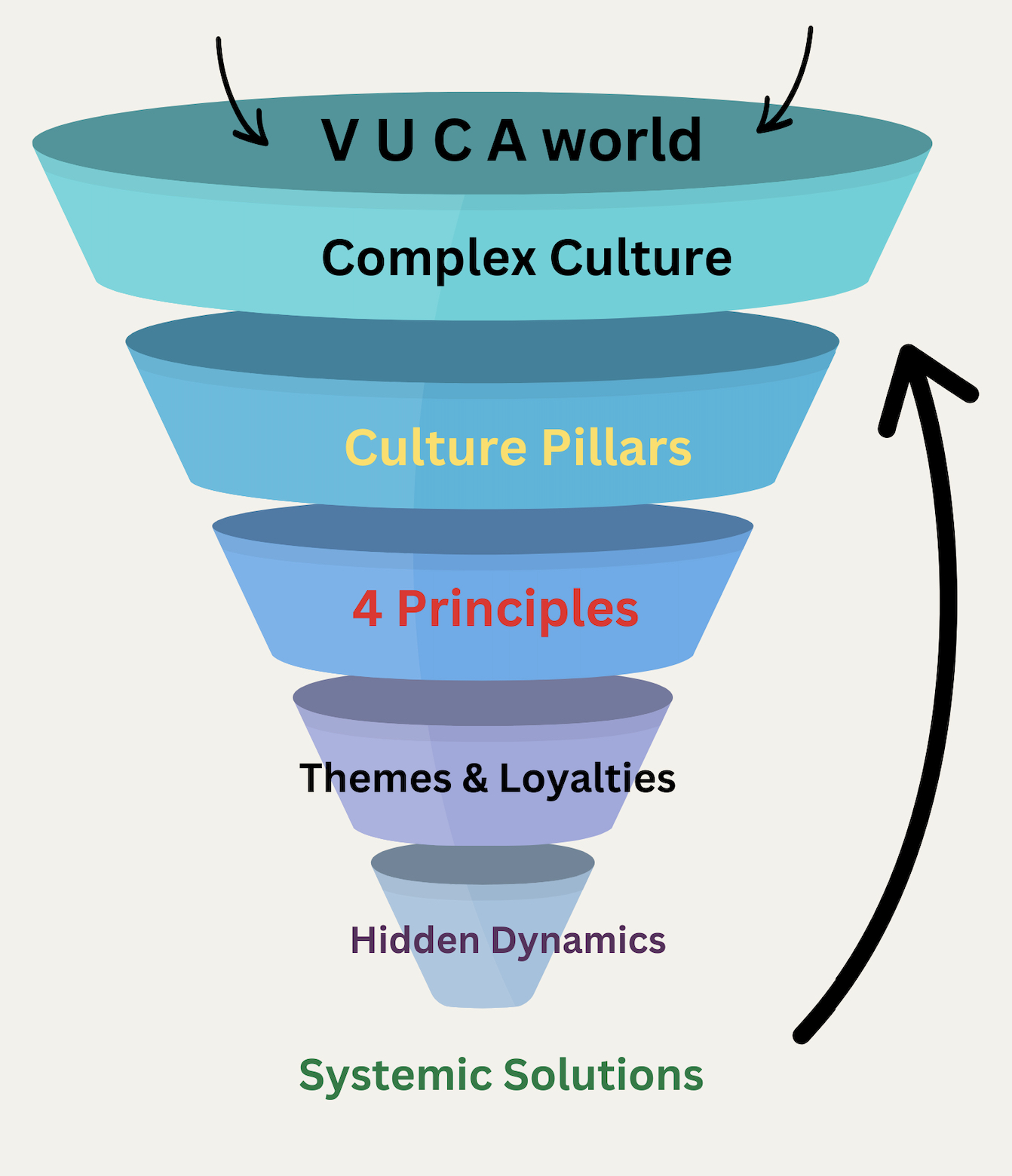
You know how to listen, build trust, ask powerful questions, challenge assumptions, work with behavior, and help people move…
Yet at a certain point, experienced coaches and consultants reach an edge that has little to do with competence.
Becoming a Culture Strategist does not ask you to throw away the professional skills that made you effective.
It lets you use those skills and recognize what an individual or interpersonal frame can overlook…
Sometimes the best move is still a familiar coaching move. But SI and Culture Strategy will give you a broader perspective, deeper insight, and more options.
You’ll have a clearer understanding of why that familiar move belongs there or whether it is being asked to solve a problem it was never designed to solve.
A Culture Strategist holds more knowledge without more noise.
Sharper perception without false certainty.
New tools without tool collecting.
And action plans better matched to the systemic problems that are in front of you every day.
You don’t need to learn the entire Systemic Intelligence model before you begin using the lens.
Start with the next step that fits your work, your curiosity, and the problem in front of you.
Have a problem that keeps returning? The RPA gives you a structured 20-minute first systemic read and helps you see where deeper inquiry may belong.
Take the RPA →Want Systemic Intelligence to become part of how you coach, consult, and advise? CSP is a 60-day applied immersion built around a live client, team, or organizational case.
Explore the Culture Strategist Playbook →Prefer to keep working with the ideas in smaller doses? Hidden Currents explores the patterns, questions, and practical implications of Systemic Intelligence for coaches, consultants, and leaders.
Read Hidden Currents →Systemic Intelligence is not an invitation to see systems instead of people.
It invites you to see more of what is shaping the people we support and help transform.
See the person. Read the system. Act where you have leverage.